Securing the Future Together
To ensure that even students who refuse to attend school are given opportunities for the future, three Wiesbaden-based organizations are working hand in hand. The Youth School Social Work program facilitates the transition into the “Fit for a Career” project. The Hessian Business Education Center implements the project. Since last year, the school has been operated by Campus Klarenthal, which is supported by EVIM.
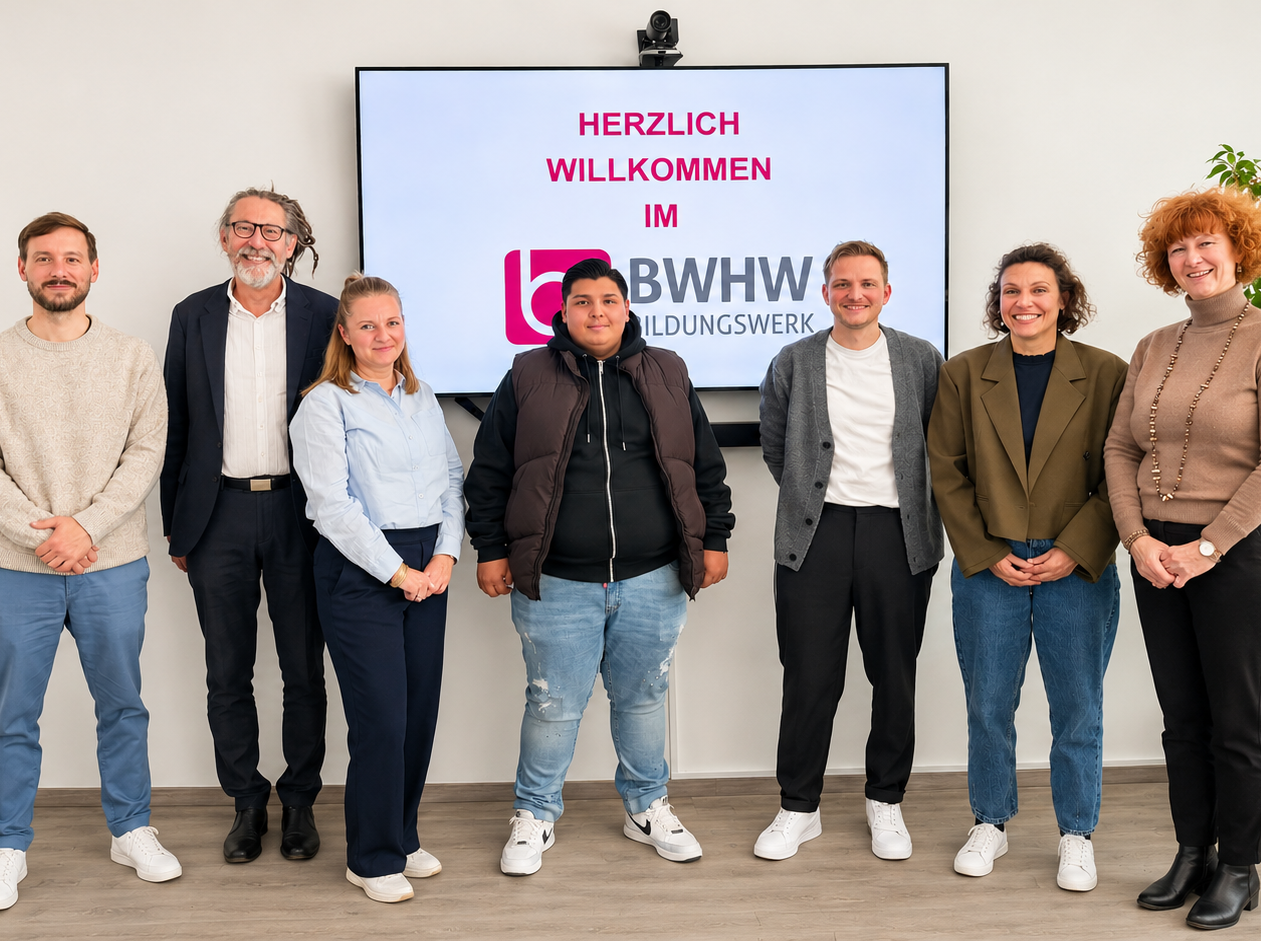
Beaming faces everywhere. No fewer than 20 out of 30 young people earned a secondary school diploma or a qualifying secondary school diploma last school year through the “Fit for a Career” (FiB) project. This program has been running in Wiesbaden since 2011, organized by the Bildungswerk der Hessischen Wirtschaft (BWHW), whose facilities also host the classes. Initially, the Kerschensteinerschule served as the school operator; this role has since been taken over by Campus Klarenthal, whose teachers lead the classes two days a week.
“The main goal is not to leave anyone behind”
“The fact that 20 out of 30 young people earned a diploma is already a strong result,” explains Dagmar Schmidt, BWHW’s Rhine-Main Regional Director. While successfully completing school is not the project’s sole goal—the project is funded by the State of Hesse’s training and qualification budget, which is administered by the State Capital of Wiesbaden’s Department of School Social Work and Youth— However, it is important that young people who have attended school for nine years—and who now attend general education schools only irregularly or not at all—maintain a sense of direction. “The main goal is not to lose anyone,” emphasizes Dagmar Schmidt. This can be achieved even after the FiB project ends through tailored follow-up measures. But with a high school diploma in hand, the young people are already very close to entering the workforce.
“I’m now looking for an apprenticeship as a hairstylist,” reports FiB graduate Nikolay Milenkov. At the Gerhart-Hauptmann School, starting in eighth grade, his grades made it seem unlikely that he would get this far. “Here, the teachers explained things better, and if I didn’t understand something, I could keep asking until I got it,” explains the 17-year-old. He still had some trouble with math, though. Still, it was enough for a grade point average of 2.6. Participating in the FiB project was the right decision. It feels good to be looking for an apprenticeship now.
Two Systems Form a Strong Team
The new school district also views the project positively. “We have an inclusive approach. Our goal is to empower people,” emphasizes Uwe Brecher, principal at the Klarenthal Campus. His experienced teachers were already well-prepared for the FiB project for several reasons. Not only because they were already accustomed to working in multiprofessional teams, for example with social educators. “They can empathize with students with special needs and find the right way to address them,” adds Uwe Brecher. What was new for the teachers, however, was that the students they taught—all aiming for a secondary school diploma—were at the same learning level, unlike in the secondary-level classes at the Klarenthal Campus. Because a strong team has emerged from these two systems and they’ve learned to monitor the participants’ progress earlier on, he hopes for even better results in the second year of this new partnership.
Entering the Workforce with Practical Experience
The other three days of the FiB project consist of one day of vocational training and two days spent, whenever possible, on internships at companies. “It’s important not to do the same thing as in school. We want to give them the experience of doing something they’re capable of, something they enjoy, with the lessons supporting that,” explains Dagmar Schmidt. For example, participants in the new cohort are currently learning how to deal with criticism. Among the strategies they’ve explored is asking how something could be done better in the future. But it also includes expressing regret that an effort didn’t yield the desired results, even though one had tried hard beforehand. “Practical skills can also include correctly reading the hands of a clock,” explains Maurice Datz, who oversees the FiB project on behalf of the BWHW. After all, the program includes young people from very diverse backgrounds. However, the primary focus is on career orientation, which involves drafting cover letters, strengthening skills, and practicing job interviews.
“Last year, we had up to 25 young people in internships at the same time,” says Maurice Datz happily. Those who don’t currently have one spend the two days set aside for this purpose looking for a placement. “I worked at three different hair salons throughout the year and learned a lot, like how to wash hair and use scissors,” reports Nikolay Milenkov. However, finding internship placements isn’t always easy these days. “It’s becoming much harder to find internships because many businesses are actually short-staffed and don’t have the time to supervise interns,” explains Dagmar Schmidt.
In any case, the need is definitely there. “Due to the limited number of spots, unfortunately not all applicants can be considered, which means there are also many rejections,” laments Yvonne Pelster from the Office of Social Work, Department of School Social Work for Youth. Each application is reviewed in detail together with the responsible school social workers, who carefully assess whether the respective requirements for participation in the program have been met. Because demand is very high, there are even correspondingly long waiting lists. (hej)