Neighborhood Development as a Key to Tomorrow's Care
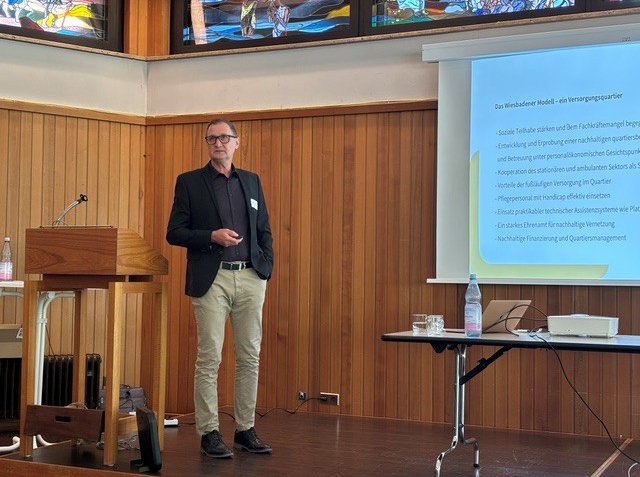
As part of the conference “Zukunft Gutes Wohnen 2026” in Wiesbaden, Peter Kiel (Head of Service Housing and Neighborhood Development at EVIM gGmbH | Elderly Care) and Torsten Anstädt (humaQ gGmbH) focused their presentation on the topic “The Neighborhood as a Place of Holistic Care.” The event, held in the Horst-Hammerstein Hall of the Ludwig-Eibach-Haus, focused on innovative concepts for sustainable housing and living in old age. Prior to the event, participants took a detailed tour of the Eigenheim-Komponistenviertel neighborhood.
The speakers pointed out that, in the future, providing needs-based care for older adults cannot take place solely within traditional long-term care facilities. Instead, neighborhood-based care structures are becoming increasingly important. The close integration of housing, care, health services, social participation, and neighborhood support creates living environments that promote independence while ensuring reliable care.
“Neighborhood development means supporting people where they live,” the speakers emphasized. The goal is to integrate care, social, and medical services in such a way that a self-determined life remains possible even as the need for support increases. Cooperation between local governments, the housing sector, care providers, and civil society actors plays a central role in this effort. EVIM Altenhilfe employs approximately 1,100 staff members and 133 trainees (as of December 2025) in 12 nursing homes, an outpatient care service, three day care centers, an SAPV support center, and nine assisted living facilities in Hesse and Rhineland-Palatinate.
The presentation highlighted that integrated neighborhood concepts represent an important response to the challenges of demographic change and can make a significant contribution to holistic and sustainable care. (pk)