Care of the Future: Breaking New Ground Together
How can we ensure high-quality long-term care in the future? In light of demographic change, growing staff shortages, and rising costs, new solutions are urgently needed. The opportunities offered by greater collaboration and community-based care models were the focus of a public expert event hosted by EVIM Altenhilfe on October 28 at the Hochheim Senior Center.
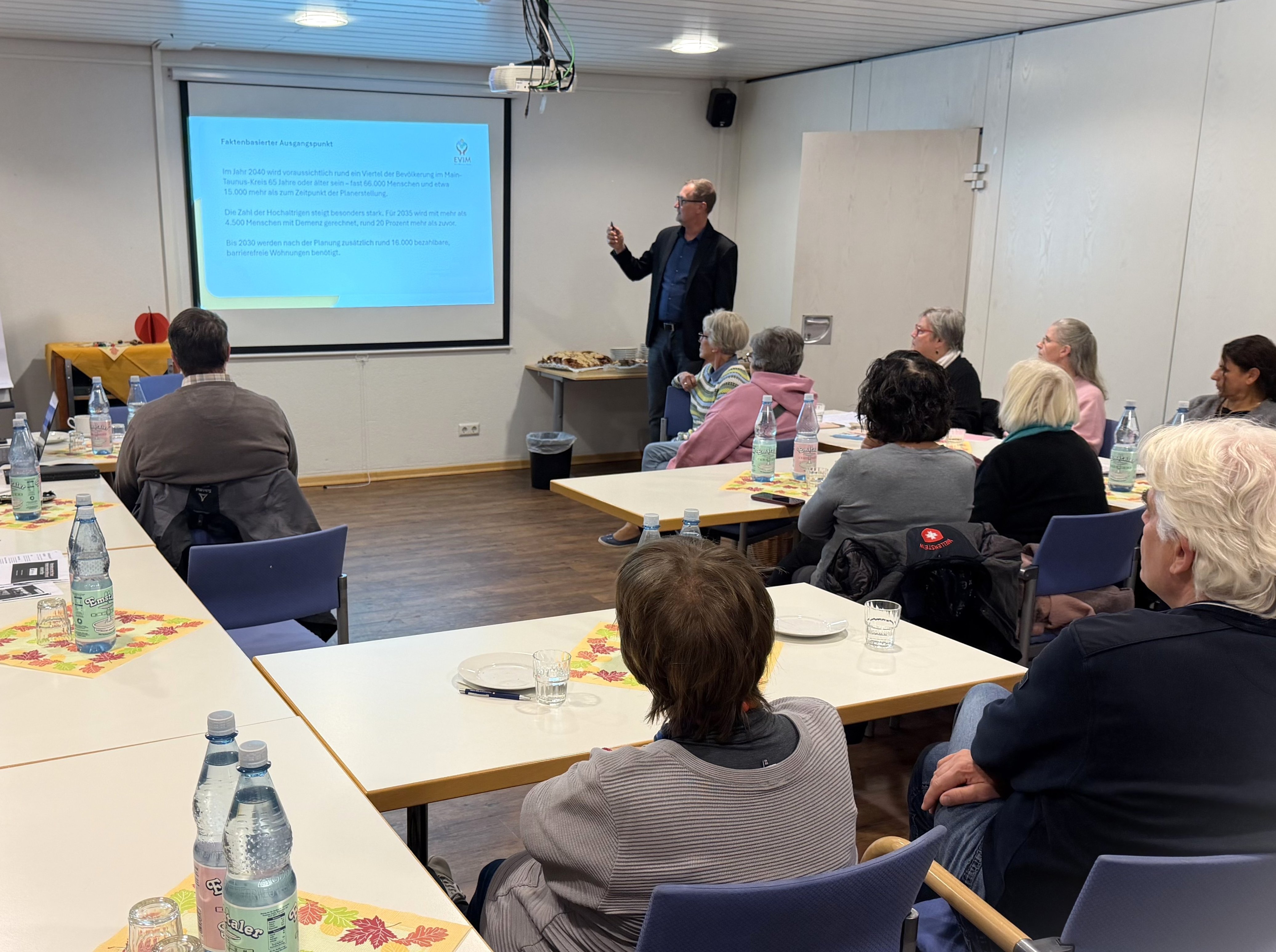
About 30 interested individuals from the fields of nursing, healthcare, hospice care, and local politics accepted the invitation. The key takeaway from the evening: “Business as usual” won’t work. But there are promising alternatives that are already being successfully tested.
As the need for care grows and resources dwindle
The baby boomers are retiring—including numerous nursing staff. At the same time, the number of people in need of care will rise significantly. Peter Kiel, Head of Service Housing and Neighborhood Development at EVIM, warned that this trend can no longer be managed with the current staffing and financial resources of residential care facilities. Although EVIM trains around 130 people annually in care professions, the number of new recruits is not sufficient to meet the demand.
Regional figures illustrate the scale of the challenge: As early as 2023, 13,683 people in the Main-Taunus district were receiving long-term care insurance benefits. Of these, around 1,500 lived in residential care facilities, while the vast majority were cared for at home. According to the district’s elderly care plan, the demand for geriatric care workers could rise by about 69 percent by 2040 compared to 2019.
“Family caregivers are the largest private care service in the country,” said Torsten Anstädt of the consulting firm humaQ, summing up their indispensable role. But even families are increasingly reaching their limits. At the same time, the financial burdens on those in need of care, their relatives, and local governments are rising.
Community-Based Care: Short Distances and Vibrant Neighborhoods
Torsten Anstädt and Andreas Schmidt from the Rehbein care service used practical examples to illustrate what new solutions might look like.
In Wiesbaden’s Eigenheim/Komponistenviertel neighborhood, EVIM and the private care provider Rehbein developed a neighborhood-oriented care concept as early as 2016. Caregivers can reach many of their clients on foot. Long travel times, the search for parking, and time pressure are largely eliminated. The time saved benefits the actual care provided. At the same time, having designated caregivers enables personal and reliable care.
But good neighborhood care requires more than just short distances. It thrives on interactions and a functioning social community. A particularly successful example is the Son(n)derBar café and bistro. What at first appears to be an ordinary dining establishment is, in fact, a hub of the neighborhood. Here, people of all generations meet for coffee, a meal, or simply to chat. The cozy atmosphere, events, and an attached DHL package shop make the café an attractive gathering place in everyday life. Someone picking up a package might just stay for a cup of coffee. People strike up conversations, get to know one another, and build connections. This fosters a vibrant neighborhood that also includes older adults and those in need of support.
The EVIM neighborhood office is directly adjacent. A coordinator addresses social concerns, connects people with support services, and fosters a sense of community. In this way, social interaction, counseling, and nursing care work together to help people live independently in their familiar homes for as long as possible.
Collaboration Instead of Isolated Solutions
A project by the Rehbein nursing service in Rüsselsheim also demonstrates that such concepts work. 139 assisted-living apartments, an in-house nursing service, and a day care center provide support tailored to residents’ needs and relieve the burden on family caregivers.
These examples make it clear: sustainable care requires more than just a few good individual services. Hospitals, long-term care facilities, outpatient services, doctors’ offices, hospice associations, and local governments must better coordinate their resources. Christa Hofmann and Verena Kurz from the Lebensbrücke e. V. hospice association in Flörsheim also reported that this can be achieved. According to the chairwoman, the hospice associations in the Main-Taunus district have intensified their collaboration and coordinated their areas of operation. This reduces travel distances and pools resources.
For Torsten Anstädt, this also involves rediscovering tried-and-true neighborhood structures: people who know one another, look out for one another, and organize support when needed. Designated contact persons in the neighborhood could play an important role here by recognizing the need for help early on and connecting people with appropriate services.
By the end of the evening, there was broad consensus: the challenges are too great to be tackled alone. The event in Hochheim is therefore intended to serve as a kickoff to bring together additional stakeholders and jointly develop new approaches for reliable, person-centered care in the Main-Taunus district. (hk)