Thousands of postcards are reaching the federal government in Berlin—Diakonie in Hesse warns of the consequences of planned social spending cuts
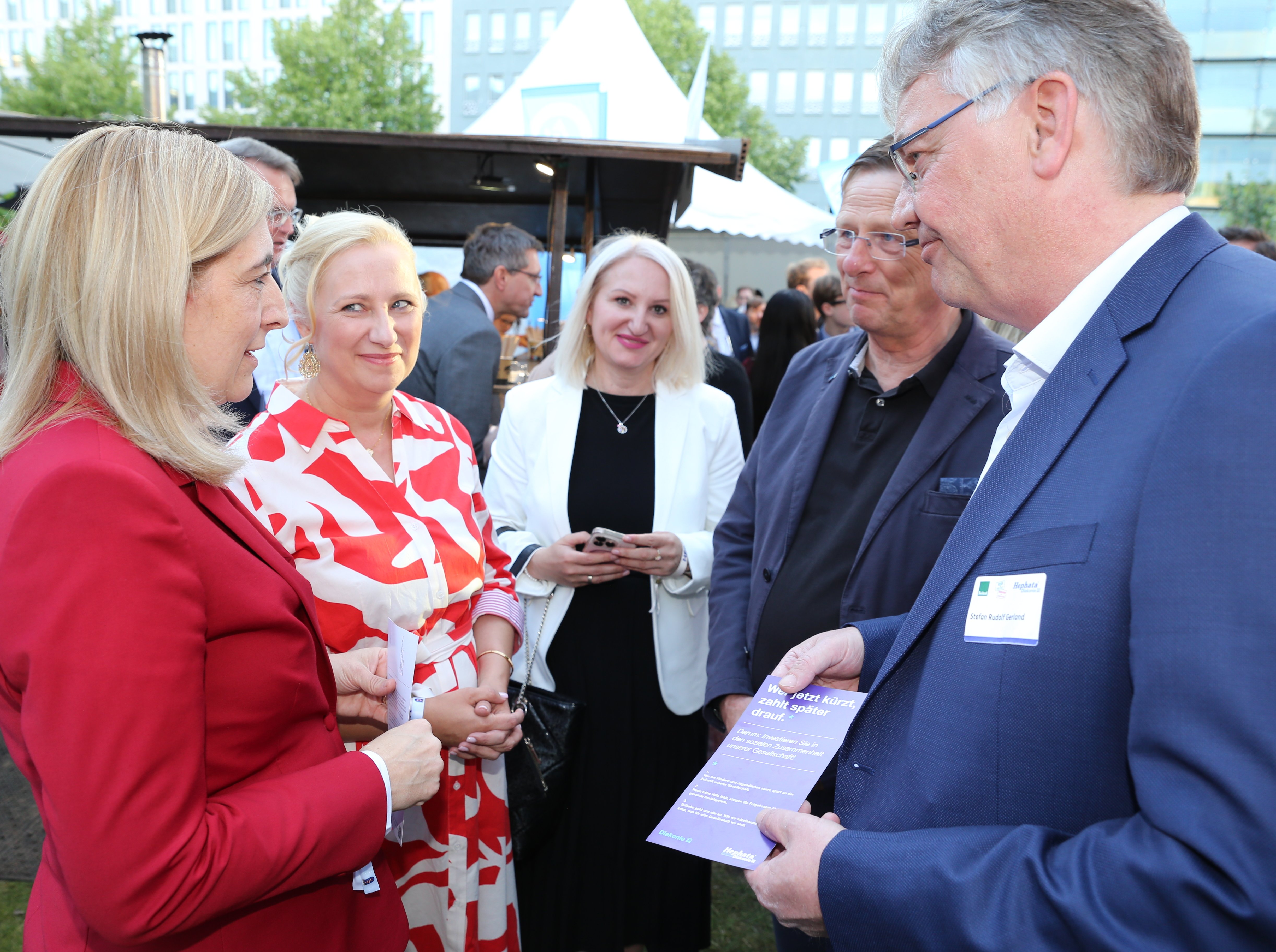
On July 8, Diakonie staged a protest in Berlin to speak out against the planned cuts to child, youth, and integration assistance. Thousands of people from Hesse wrote postcards to the federal government. Together, they are calling for social cohesion in society and highlighting the resulting costs for the entire social welfare system. At the Hessenfest held at the Hessian State Representation, Nina Warken (CDU), Federal Minister of Health, accepted one of the postcards on behalf of the recipients; all other postcards will be delivered in a single batch to the Federal Chancellery. Carsten Tag, Chairman of the Board of Diakonie Hessen, and Stefan Gerland, Chief Financial Officer of Hephata Diakonie, jointly presented the postcard to the federal minister on behalf of the many signatories.
“Those who cut social benefits today will pay double tomorrow—socially and financially. Sustainable reforms for a future-proof welfare state are not conceived at a desk, but emerge from real-world experience. Behind each of these stories are people and their experiences. These voices must be heard. After all, a strong welfare state is the foundation of social cohesion. Those who cut funding here risk social division and jeopardize social cohesion in our country. Diakonie stands ready as a reliable partner to policymakers—for solutions that work, avoid follow-up costs, and ensure the cohesion of our society,” emphasizes Carsten Tag, Chairman of the Board of Diakonie Hessen.
As the largest provider of integration and youth services in Hesse, Hephata Diakonie has for years been highlighting its commitment to people with disabilities to policymakers at the Hessenfest and initiated the handover on-site.
Stefan Gerland, Chief Financial Officer of Hephata Diakonie, explains: “Behind these postcards are people who experience every day just how important reliable support is for participation, self-determination, and social cohesion. Staff, clients, family members, and supporters have sent a clear message together: Social support is not something to cut back on.” Regarding the attractiveness of social work professions, Gerland emphasizes: “The proposed budget cuts not only aim to significantly reduce services for our clients but also call into question the collectively bargained wages of employees in the social sector. This calls into question the attractiveness of social work professions as a whole and will have long-term effects on the social infrastructure and the services it provides. This mistake has already been made once before in long-term care insurance—with far-reaching negative consequences.”
Along with the State Association and Hephata Diakonie, other organizations and institutions involved in child, youth, and integration services in Hesse participated in the campaign, including Bathildisheim e.V., EVIM, Leppermühle e.V., Mission Leben, Nieder-Ramstädter Diakonie, St. Elisabeth-Verein e.V., Tanner Diakoniezentrum gGmbH, and the Regional Diakonische Werke. In addition, private individuals from the circles of employees and those affected signed the postcards. The presentation in Berlin highlights this commitment and, at the same time, demonstrates the deep concern over the proposed budget cuts.
The postcards are part of a nationwide campaign by Diakonie Deutschland under the slogan “Those who cut today will pay for it tomorrow.” Nationwide, well over 100,000 cards have already been signed. The goal is to directly confront political leaders with the voices of employees, those affected, and supporters.
The backdrop to this is the federal government’s plans to make massive cuts to key social services. Among other things, this would affect assistance for families and children, youth welfare services, and benefits for people with disabilities. Diakonie warns of serious consequences for social participation and the ability to lead self-determined lives.
Today’s action unites the protest into a clear message to policymakers: Social infrastructure is not a discretionary benefit—it is a prerequisite for social cohesion and long-term stability.
(Press release from Diakonie Hessen; Berlin/Frankfurt am Main, July 8, 2026)