What Can Grow from a Beginning
Four years after Ukrainian youth were taken in, the open house showcases how the support services for young refugees at the EVIM Youth Services location in the Ludwig-Eibach-Haus have evolved, and how Kyrill has made his way toward an independent life.
As Kyrill walks through the rooms of the Sonnenberg residential group this afternoon, much has changed since four years ago. Back then, he was 16 years old and had just arrived in Wiesbaden from Ukraine. Today, he has completed his vocational training, has a permanent employment contract, and lives in his own apartment. For the open house, he has returned to the place where his new life in Germany began.
Kyrill’s life changed overnight with the Russian invasion of Ukraine. As a young competitive athlete, he was part of a group of teenagers who were evacuated from the country through a relief effort organized by the Wiesbaden Judo Club. In cooperation with EVIM Youth Services and the Youth Welfare Office, the young people were given temporary shelter at the Ludwig-Eibach-Haus. “Back then, we were housed on the fifth floor,” Kyrill recalls. A lot had to be organized in a very short time.
One person who witnessed those first few days is Carmen Gloger. She works as a housekeeper in the residential group. She still remembers the phone call from four years ago clearly: An entire group of Ukrainian teenagers was to be taken in, and her help was urgently needed. “We practically improvised everything in no time at all, including the meals. It was almost like working in a commercial kitchen,” she says with a smile. Kyrill quickly caught her attention: “He was very nice and could even speak a little German.”
Step by Step Toward Independence
What began as an ad hoc effort back then has evolved. Today, the renovated ground floor and basement of the Ludwig-Eibach-Haus house two care units run by EVIM Youth Services. Eight young people, ages 12 and up, live in the Sonnenberg residential group. The Flex Sonnenberg youth residential group supports older adolescents and young adults both in-house and as they transition toward independence. This includes additional care spaces at the Lindenhaus and on Kleiststraße.
Kyrill’s story shows how this path can lead to success. Having fled his homeland shortly before taking his high school graduation exams, he earned his diploma through e-learning and with the support of Ukrainian teachers. He learned German up to level B2 and began an apprenticeship as an office management assistant. He has since successfully completed his training and now holds a permanent position with a major employer in Wiesbaden. After living in various housing options provided by EVIM Youth Services, he now lives in his own apartment.
For Regional Director Patrick Lahr, this journey exemplifies the goal of social-educational work: to provide young people with a sense of security and, together with them, to develop sustainable academic, professional, and personal prospects. The teams work closely with schools, youth welfare offices, government agencies, and other network partners to achieve this.
A Temporary Home That Enables Growth
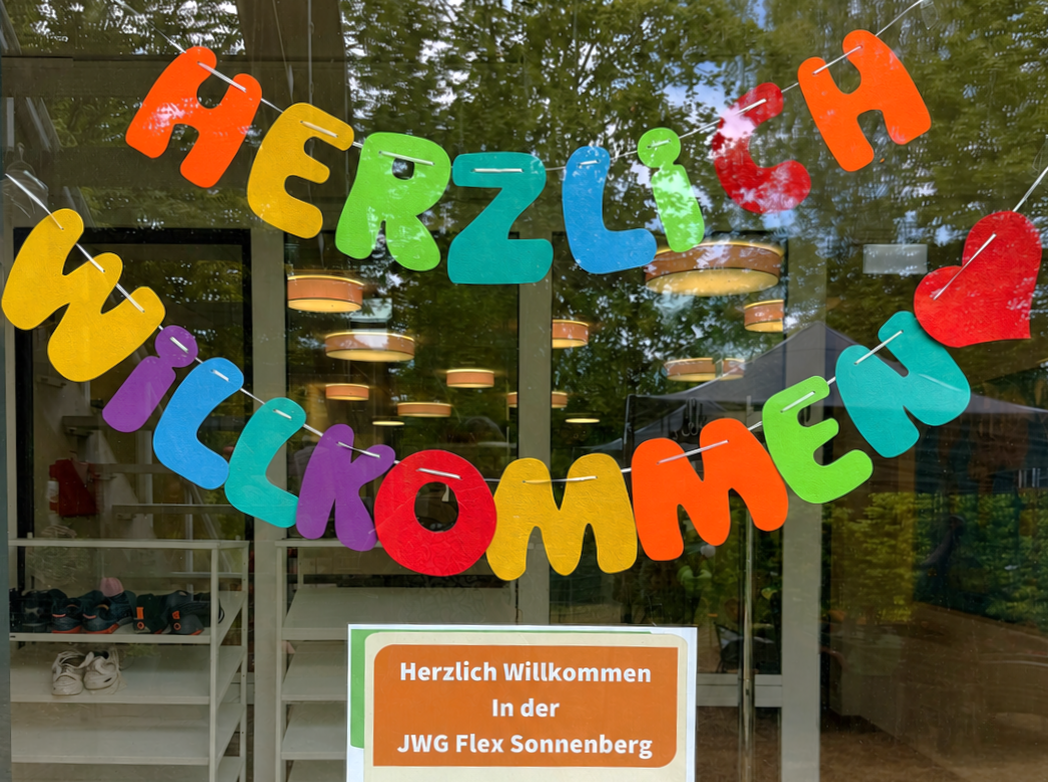
At the open house, the teams showcased the spaces they moved into a year ago. Common areas, an open kitchen, and cozy nooks define this modern living environment. Both floors open out onto the garden—with space for barbecuing and gathering, currant bushes, and herbs that Carmen Gloger enjoys using in the kitchen. “Here, everything is freshly prepared and cooked healthily,” she says.
The fact that youth services and senior care operate under one roof makes this location even more special. “Together, we’re creating a multigenerational home in a professional setting,” says Patrick Lahr. This fosters mutual understanding and provides young people with opportunities for practical experience. For example, one of the young people in the program completed his voluntary social year at the senior center.
During the open house, this sense of community came across as completely natural. Guests included partners from the Youth Welfare Office, former youth in care, the EVIM board, and the management and regional directors of youth welfare services. And as is often the case, the open kitchen became a gathering spot around the delicious buffet that Carmen Gloger had prepared together with the team.
Kyrill also reunited with familiar faces there. He remains in contact with some of the young people and the support team to this day. His parents continue to live in the Russian-occupied part of Ukraine. This makes his journey all the more telling of what can be achieved in four years when a young person seizes their opportunities and has people by their side who reliably support them. Patrick Lahr therefore also gives a positive assessment of the facility: “We have continuously evolved and have grown into two large support units that today combine residential and outpatient services as well as programs to help young refugees become independent.”
Kyrill no longer needs this support today. The fact that he still enjoys coming back is a telling sign of what professional youth services, provided with both heart and mind, can achieve. (hk)
More information about the support services: