Commemoration firmly integrated into the curriculum at Campus Klarenthal – Stumbling blocks also on Bismarckring in Wiesbaden
Traffic roared loudly along Bismarckring, and rain pelted down on the tent roof on that autumn day last year. Nevertheless, the students from Campus Klarenthal and Mittelstufenschule Dichterviertel listened attentively as Inge Naumann-Götting from the Aktives Museum Spiegelgasse read aloud information about the lives of the three people whose last freely chosen residence was at Bismarckring 6.
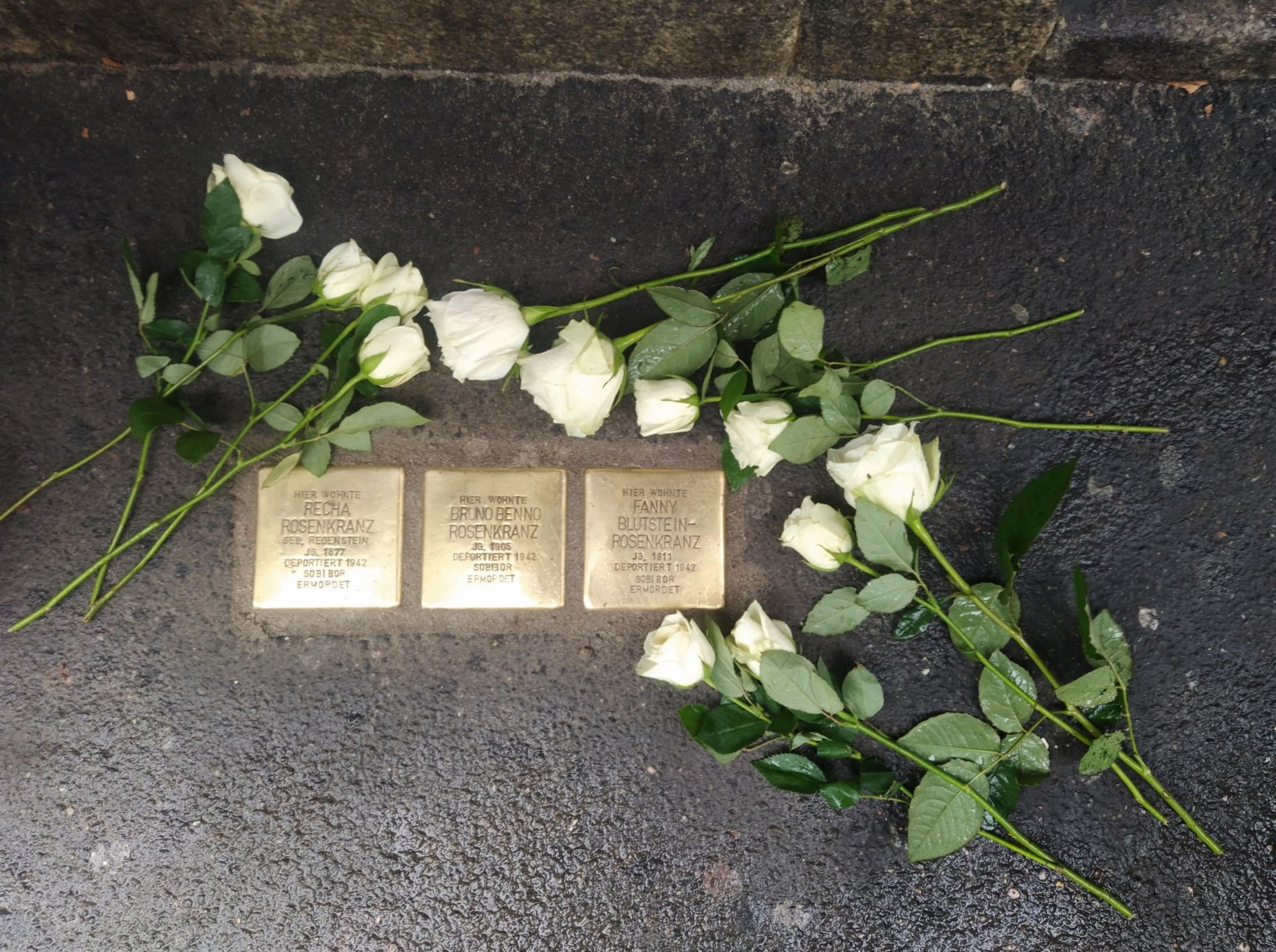
Their names were Recha Rosenkranz, Bruno Rosenkranz, and Fanny Blutstein. At the beginning of September, three Stolpersteine were placed in the sidewalk in front of the house in their memory. The two employees of the Wiesbaden Civil Engineering Office expertly inserted the three shiny gold cubes from the workshop of Cologne artist Gunter Demnig into the pavement, which the initiator of the Stolperstein campaign personally helped to lay that day. "It was a moving moment for all of us," said Signe Ross, a teacher at Campus Klarenthal. These are three of a total of 23 stones that were laid during this year's campaign. According to Elisabeth Lutz-Kopp from the Active Museum Spiegelgasse, there are now 807 stumbling stones in front of 437 houses in Wiesbaden. And the list is still long. A Stolperstein costs 120 euros, and some are sponsored by patrons—which can be associations, local councils, homeowners, relatives—or, as in the case of the Rosenkranz family, two school classes. Campus Klarenthal with teacher Signe Roß is a long-standing partner of the Active Museum, where remembrance is an integral part of the curriculum. At the request of the middle school, Signe Roß has now also advised them on this topic, and here too, more space will be given to remembrance in the future. And so, for the first time, a class from this school was present. After the family's life stories had been read aloud, the students laid white roses. For Signe Ross, this joint action is something very special. "We are delighted that this successful start will be continued and that it supports active engagement with the Holocaust," says Signe Ross, praising the newly established cooperation.
Keeping the memory alive
Recha Rosenkranz was born in 1877 near Darmstadt and married a man from Wiesbaden. They ran a furniture store at Blücherplatz 3. Her husband died in 1929, and Recha and her son Bruno, born in 1905, continued to run the business. Under Nazi rule, they were forced to give it up. From 1940 onwards, the two lived on Jewish welfare. In 1938, Bruno had married 27-year-old Fanny Blutstein, a seamstress from Dortmund, according to Jewish rites. The next day, she was deported to Poland with her family, her parents and six siblings, so that the civil wedding could no longer take place. The young woman managed to escape in Stendhal and returned to Wiesbaden, where Recha and Bruno lived at Bismarckring 6. Bruno and Fanny were unable to obtain the documents necessary for a wedding ceremony. They had to move into a so-called "Judenhaus" (Jewish house) at Rheingaustraße 5, today Marcobrunner Straße. In 1941, Fanny, Bruno, and Recha were deported to Poland and murdered in the same year. The rest of Fanny's family had managed to flee to Palestine.
The members of the Active Museum research these life stories and record them on memorial sheets, one of which is presented each month in the memorial room of Wiesbaden City Hall. They can also be viewed online at https://www.am-spiegelgasse.de. In addition, there is an exhibition on the subject of stumbling stones and memorial sheets in Spiegelgasse. (aja)