Look. Help. Act. EVIM Strengthens Prevention and Protection Against Sexual Violence
How can people in social institutions be better protected against sexual violence? What responsibilities do leaders bear? And how can we foster a culture of vigilance and action?
The EVIM General Conference, in collaboration with Diakonie Hessen, addressed these questions in mid-June in Wiesbaden. More than 80 managers and leaders from all fields of work gathered at the Altes Gericht to engage in an in-depth discussion of prevention, intervention, and coming to terms with sexual violence.
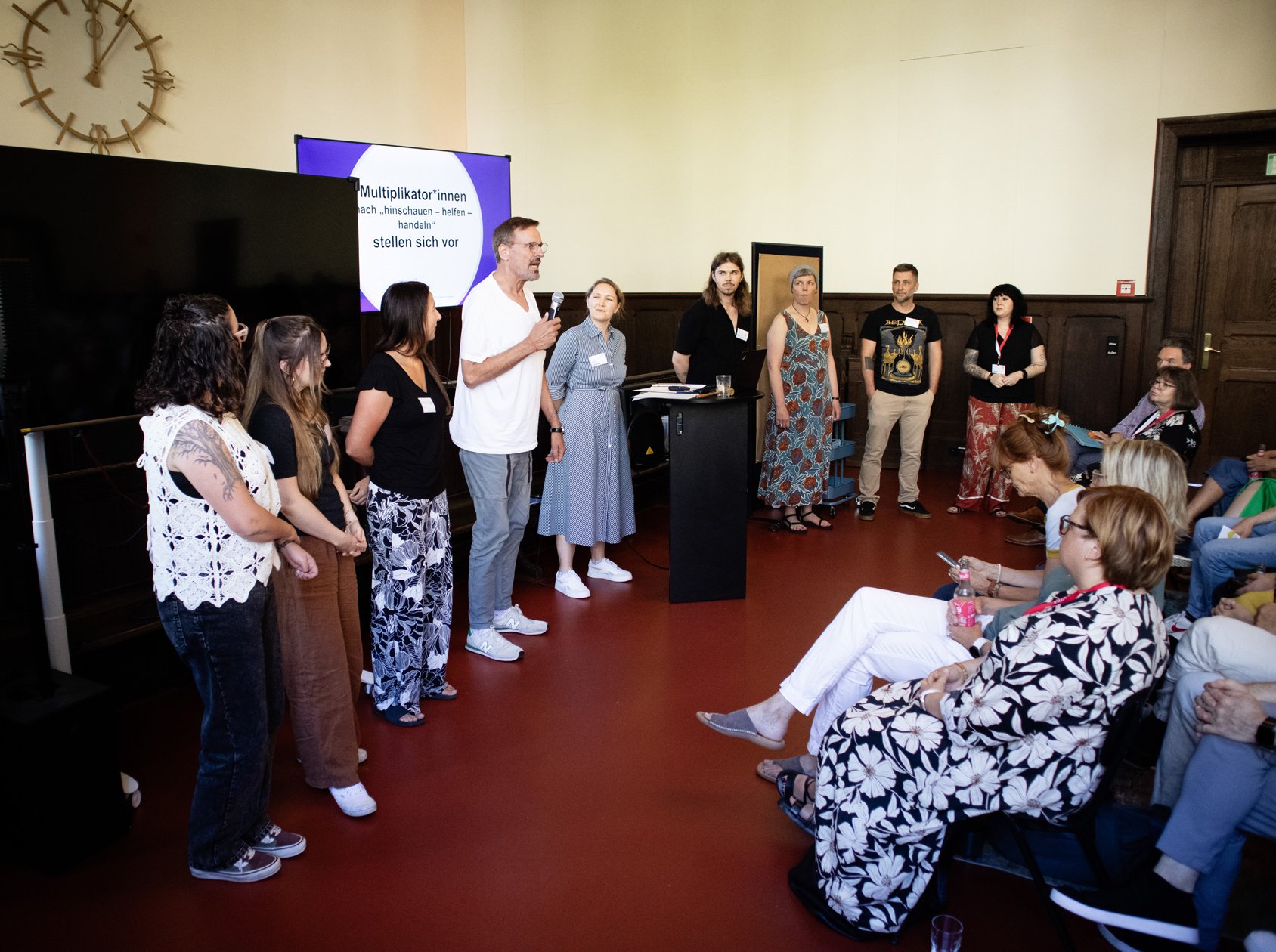
As a major diaconal social enterprise in Hesse, EVIM has thus taken an important step toward raising awareness among all its employees. The event also marked the start of a long-term process: In the run-up to the event, 18 EVIM trainers were trained in cooperation with Diakonie Hessen. In the future, they will conduct training sessions for all employees and permanently embed the topic within the facilities.
“Sexualized violence can occur anywhere where people are dependent on one another and power dynamics exist. That is why, as a diaconal organization, we must be vigilant, take responsibility, and establish clear courses of action,” emphasized EVIM Chairman Matthias Loyal in his opening remarks. Christopher Schmitt, Head of Volunteer Engagement at EVIM, skillfully moderated the EVIM General Conference.
Findings from the ForuM Study
Sophia Schreiber, Violence Prevention Specialist at Diakonie Hessen, provided the technical introduction. In her keynote address, she presented key findings from the ForuM study. The nationwide study on sexualized violence in the Protestant Church and Diakonie shows that prevention, intervention, and coming to terms with the past must be consistently further developed. At the same time, it highlights how important it is to openly address power structures, responsibilities, and institutional risks.
The study concludes that sexualized violence must not be viewed as a problem of individual persons. Rather, an organizational culture is needed that recognizes boundary violations, takes those affected seriously, and ensures safe reporting channels. Prevention does not begin only when a case is suspected, but with a shared attitude in everyday life.
Sharpening Awareness
An awareness-raising exercise in small groups demonstrated just how differently situations can be perceived. Participants discussed case studies and exchanged their assessments. It quickly became clear that the evaluation of potential boundary violations often depends on personal experiences, relationships, understandings of roles, and the specific context.
Particular attention is required, especially in situations that do not seem clear-cut. The exercises highlighted how important it is to address uncertainties, share observations, and seek professional support.
Taking Responsibility Together
In the afternoon, the managers worked in four thematic forums. The focus was on basic training for employees, reporting channels, intervention, protection strategies, the mission statement, and questions of attitude. The results were then presented, discussed, and prioritized during a gallery walk.
This revealed that numerous concepts and guidelines for action already exist across EVIM’s various business units. The task now is to consolidate these approaches, further develop them, and make them accessible to all employees.
Training the multipliers forms an important foundation for this. The training program “Look – Help – Act,” developed by the EKD and Diakonie Deutschland, imparts knowledge about the dynamics of sexualized violence, legal foundations, perpetrator strategies, and options for prevention and intervention. At the same time, it encourages participants to reflect on their own attitudes and develop the ability to pass on this knowledge in training sessions.
An issue that concerns us all
At the end of the conference, there was consensus on the importance of the issue. Sexualized violence must neither be treated as a taboo nor swept under the rug. Every form of violence harms people and shatters trust. Or, as was stated repeatedly that day: “Every victim is one too many.”
The leaders signaled their support for the continued work of the multipliers. Together, based on the EVIM mission statement, they aim to create a framework that provides guidance, ensures safety, and protects those affected. After all, prevention is most effective where people pay attention, take responsibility, and take action. (hk)
The EVIM advocates for the prevention of sexual violence (in alphabetical order): Insa Biedermann (Association), Sabine David (Education), Sylvia Deiseroth (Elderly Care), Eva Dräger (Elderly Care), Moritz Dwinger (Education), Julia Eckerle (Elderly Care), Simon Henrik Flegler (youth services), Kathrin Fuchs-Kautzky (social inclusion), Simone Graß (education), Jeanette Herve (education), Ella Jaekel-Hoffmann (social inclusion), Franziska Kaiser (youth services), Julian Kerber (Association), Joan Kreft (Senior Services), Indre Schuch (Education), Thomas Schulze (Education), Laura Seidl (Youth Services), and Edgar Slatnow (Inclusion).