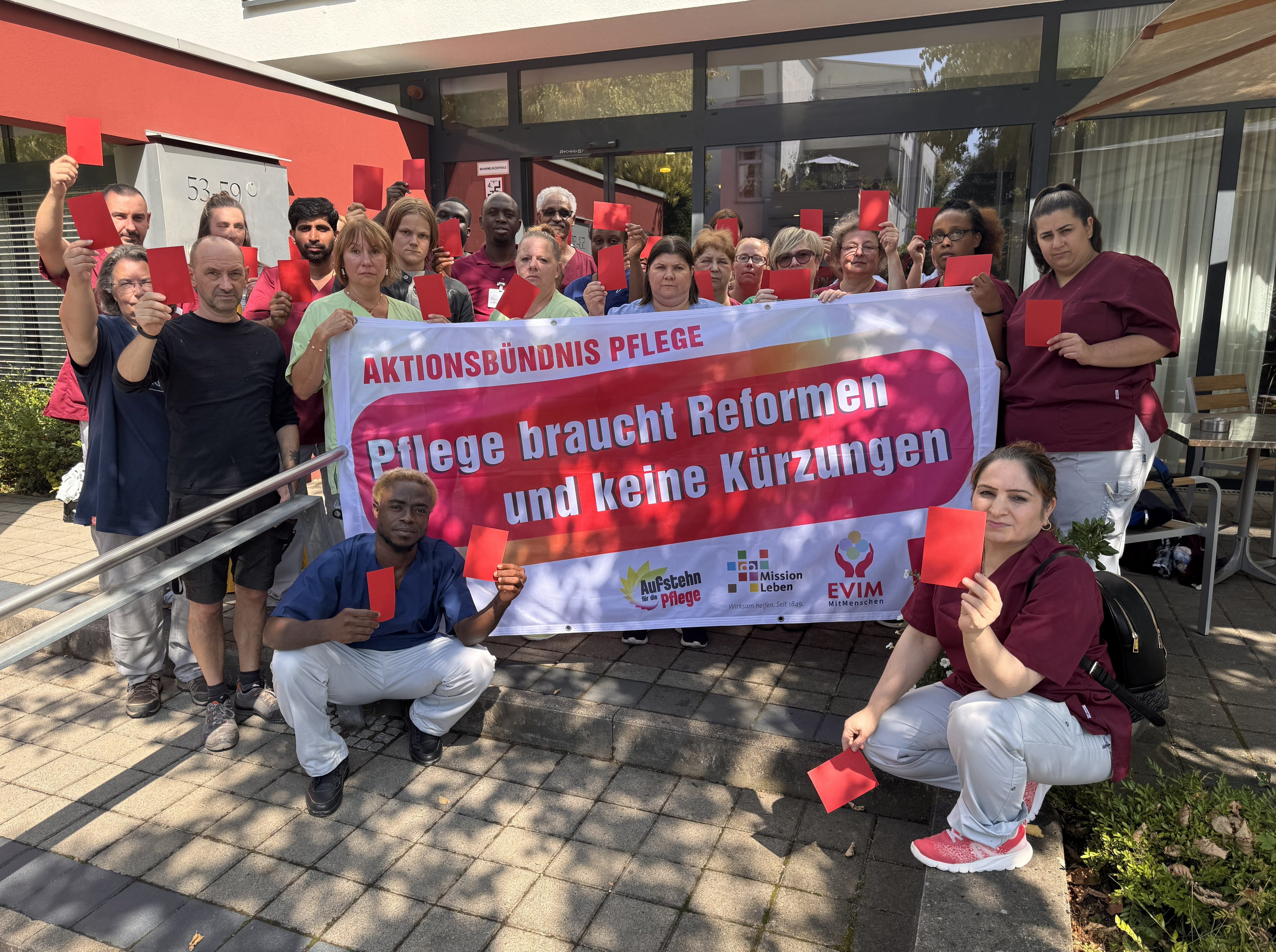
Hessen Gives the "Care Reform Act" (PNOG) a Red Card
(Joint Press Release) Caregivers, nonprofit organizations, and those affected are issuing a joint warning: This law cuts funding at the expense of those who provide care and those who depend on it. The law does not solve any care problems—it shifts costs, responsibility, and the burden onto employees, those in need of care, and their families. In response to the federal government’s plans to overhaul the long-term care system, the United Services Union ver.di, welfare organizations, and self-help groups for people in need of care have joined forces to form the “Care Action Alliance.” Through this alliance, they are channeling their strong criticism of the draft reform and will work together in the future to oppose it both substantively and through direct action.
The draft bill titled “Long-Term Care Reform Act” (PNOG) provides, among other things, for a four-year suspension of the rule requiring that pay in long-term care for the elderly be based on collective bargaining agreements. In addition, wages set by collective bargaining agreements are no longer to be fully reimbursed. This stands in clear contradiction to the federal government’s stated goal of strengthening collective bargaining coverage.
Stefan Röhrhoff, State Director for Health, Social Services, Science, and Education at ver.di Hesse: “In elder care, the staffing shortage will continue to worsen in the face of rising demand. It is for good reason that adherence to collective bargaining agreements has been in place in the care sector since 2022. Anyone who sacrifices mandatory collective bargaining wage payments is mocking the hard work of all those who devotedly and professionally care for the elderly and the sick. The Federal Ministry of Health’s approach amounts to a full-scale attack on the staff of long-term care facilities.”
The draft would also tighten the assessment criteria to such an extent that, compared to current law, nearly 12 percent fewer people would be classified as requiring long-term care. This would shift the mix of care levels downward in nursing homes. This has direct consequences for staffing levels: The higher the care level, the more staff can be deployed and reimbursed. If people are classified at lower levels in the future, staffing levels will decrease on paper—even though the actual care burden does not disappear.
The result would be an increased workload for the same number of residents. The planned cost-cutting measures would thus primarily affect those in need of care and care staff. “The PNOG strikes at the very heart of outpatient care,” says Carsten Tag, Chairman of the Board of Diakonie Hessen. The draft bill threatens to remove proven support in the form of counseling, guidance, and accompaniment for people in need of care from the scope of responsibilities of outpatient care services. “These services are not administrative tasks, but rather the core of professional care. Anyone who removes care services from the scope of care support weakens precisely the structures that support and stabilize people in need of care and their families in their daily lives. Instead, the law must mandatorily integrate professional care, secure counseling and training services, and guarantee full funding for this demanding work,” Carsten Tag continued.
“The draft bill does not solve any of the structural problems in care. Instead of sustainable reforms, we are seeing cuts that are driving skilled workers out of the care sector, weakening collective bargaining agreements, and worsening support services for people in need of care and their families,” says Dr. Yasmin Alinaghi, State Executive Director of the Paritätischer Wohlfahrtsverband Hessen.
The German Red Cross (DRK) in Hesse also concurs with these statements. DRK State Director Nils Möller says: “A reform of long-term care insurance is necessary to ensure the long-term sustainability of the care system. However, we must not lose sight of the fact that many people in need of care rely on existing support services that enable them to live as independently as possible in their own homes. Structures that relieve the burden on those in need of care and their families and promote staying at home should therefore be preserved and strengthened, rather than weakened.”
The alliance agrees that if the plans are implemented in their current form, the cost savings would be passed on entirely to those affected and to workers, rather than finally placing long-term care insurance on a solid, future-proof financial footing. “Family caregivers need more relief—not less. The planned cuts—including the elimination of respite care and reductions in pension points—deprive them of urgently needed time off, and the reduction in pension points exacerbates the risk of poverty in old age. At the same time, preventive measures must explicitly target family caregivers and protect their health in the long term. Anyone who wants to ensure home care must not put family members at a disadvantage through this reform,” says the self-help organization for family caregivers “Wir pflegen!”
What the Federal Ministry of Health is announcing as a reform is nothing more than a program of cuts at the expense of employees and people in need of care.
Currently, the coalition is reaching out to the public with a photo campaign and a social media campaign featuring care workers and those affected. The next planned action is participation in a demonstration. On September 26, the German Trade Union Federation (DGB), together with other campaign partners, is calling for nationwide rallies against cuts to social services. This includes Hesse: A demonstration will begin at 11:00 a.m. at Frankfurt’s Willy-Brandt-Platz. One of the key demands is the full refinancing of collectively bargained wages in the care sector.
Contact Diakonie Hessen
Sonja Driebold
, Head of the Health, Aging, and Care
Division, Tel.: +49 69 7947 6266