Shaping Transitions Together: How EVIM Strengthens the Path to the Open Labor Market
Since August 2025, the EVIM Workshop Network has been participating in the Inclusion and Transition Management Project (InklUMa for short). Funded by the Hessian Ministry of Labor, Integration, Youth, and Social Affairs and the Integration Office as part of the HePAS program, this three-year project has a clear goal: to sustainably improve transitions from workshops for people with disabilities into the general labor market—structurally, strategically, and through close collaboration among all stakeholders.
A solid foundation as a starting point
The EVIM Workshop Network brings a strong starting position to this task. With established programs such as Startklar and the Jobfabrik, there is already a long history of successful work in vocational integration. Here, people with disabilities receive individualized support to facilitate internships, off-site work placements, or jobs subject to social insurance contributions, emphasize project coordinators Noura Schmuck and Kathrin Eder along with their teammate Jenny Wächter.
This experience forms the foundation for the next step in development: moving from primarily case-by-case placement to systematically structured and strategically maintained networking. A first milestone in the project is the “Business Talk” in collaboration with the Hattersheim Economic Development Agency—an informational workshop for interested companies in the region—as well as an initial networking workshop early this year.
Networking as the Key
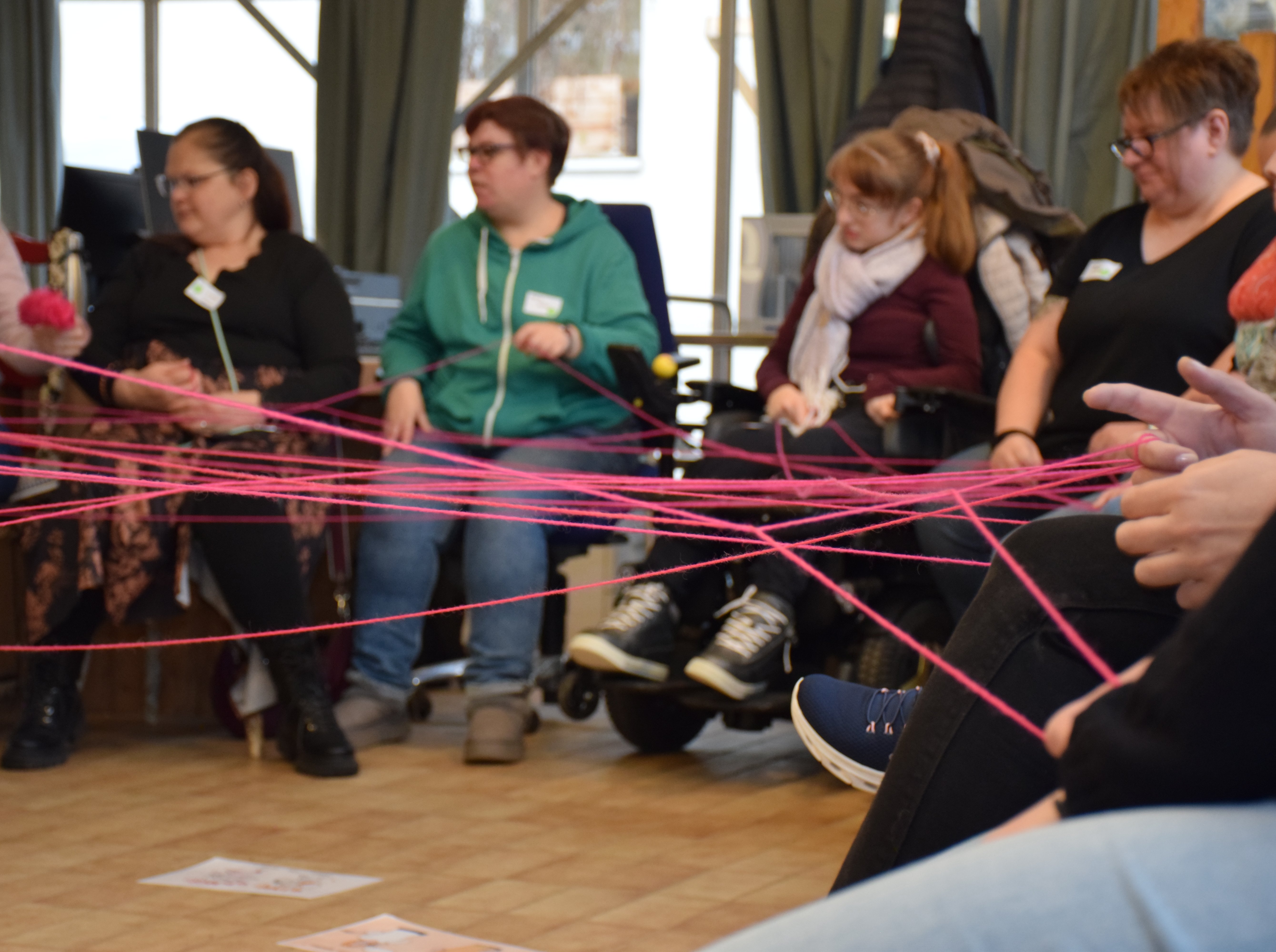
The networking workshop brought together clients and skilled workers from the Schlockerhof and the Reha-Werkstatt. In an open working atmosphere, participants collaboratively identified existing partnerships and areas where gaps still exist. A key finding: A broad network already exists, but this potential is not yet being fully realized everywhere. At the same time, it became clear that new partnerships must be specifically established, particularly with companies that have had little exposure to inclusive employment to date.
The strength of the workshop lay not only in the results but in the nature of the collaboration: All participants met on equal footing, ideas were taken seriously, and perspectives were shared. Many participants described feeling “heard”—a crucial building block for sustainable development processes.
Where Development Is Needed
Despite positive examples, there remains a need for development both outside and within EVIM. Many companies and institutions have so far known too little about the concrete possibilities for employing people with disabilities. There are often uncertainties or reservations, for example regarding resilience, organizational implementation, or perceived risks, reports Noura Schmuck. Yet practice paints a different picture: employment models can be designed flexibly; for instance, starting with just a few days a week is possible. Additionally, there is always the right to return to the workshop. This serves as a safety net for everyone involved, explains Noura Schmuck.
Within EVIM as well, the workshop highlighted that existing opportunities could be leveraged even more effectively. Good examples—such as in elder care or daycare centers—show how beneficial inclusive collaboration can be. Especially in daycare centers, situations arise where inclusion becomes a natural experience for children and relieves the burden on staff. There is clear potential for development here: making existing knowledge more visible, sharing experiences, and utilizing internal networks even more intensively.
Mobility as a Decisive Factor
Another key issue is mobility. For many clients at Schlockerhof, using public transportation poses a major challenge, especially in unexpected situations such as delays, track changes, or service cancellations. EVIM is already working intensively to strengthen confidence in handling such situations. Training, guidance, and support services help promote independence. At the same time, complementary solutions such as carpooling should be further developed. Mobility is thus more than just an organizational issue. It is a fundamental prerequisite for participation in working life.
What Works: Guidance and Trust
A key factor in success is EVIM’s comprehensive support system. Specialists not only support clients but also advise family members, legal guardians, and companies. This ongoing support helps reduce uncertainty and build trust. Information, personal engagement, and professional expertise consistently prove crucial in opening up new possibilities. Experience shows: When all parties involved are well-informed and supported, sustainable employment relationships and genuine prospects for a self-determined life emerge.
Leveraging synergies and strengthening structures
The focus is clearly on the future. A key priority is to further intensify collaboration between the Startklar and Jobfabrik divisions and to leverage existing contacts in an even more targeted manner. Regional strengths should be more closely linked: for example, other divisions are already benefiting from the strong network in Hattersheim. New partnerships are also being actively established in Wiesbaden, Idstein, and Oestrich-Winkel. A planned exchange meeting in May will further advance this process. The goal is to systematically leverage synergies, pool knowledge, and jointly attract even more companies and institutions to inclusive employment. (hk)