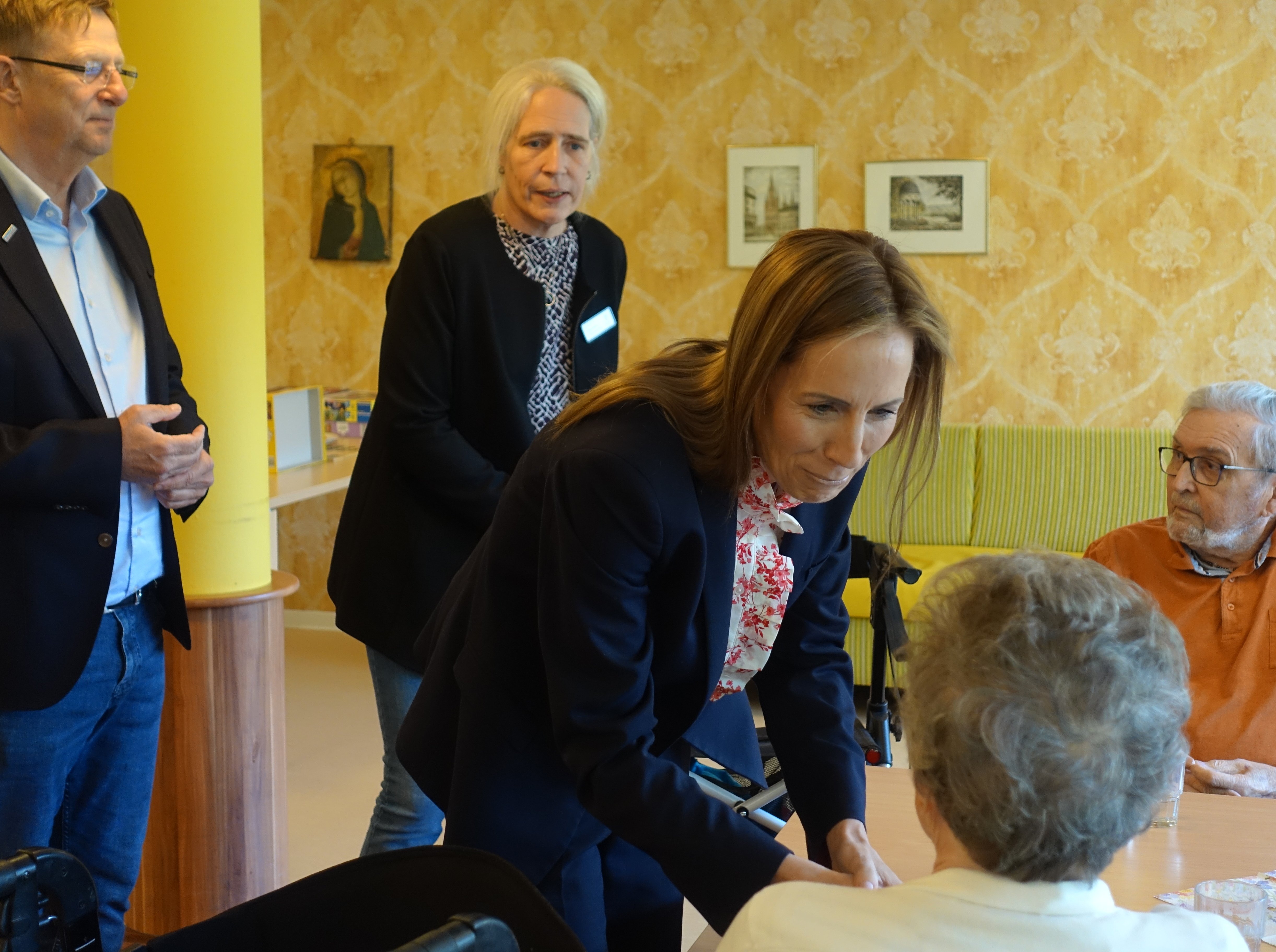
State Parliament President Visits the Ludwig Eibach House
To mark International Nurses Day, Astrid Wallmann (CDU) is visiting the EVIM Senior Center Ludwig-Eibach-Haus. Together with representatives from Diakonie Hessen, she is speaking with residents and staff and learning about key future issues in the field of nursing, such as digitalization and cross-sector collaboration.
Time for Connection and Exchange
The President of the Hessian State Parliament takes away a lot from her visit to the EVIM Altenhilfe facility. It begins with her visit to a group of three residents each from different living areas of the Ludwig-Eibach-Haus. A resolute lady laments that bus service is limited on holidays of all days. While Wallmann asks for understanding regarding the reduced schedules on such occasions, she promises to pass on the concern to the local council of Wiesbaden’s Northeast district, where the facility is located. When she asks how mobile her conversation partners still are, she learns that one of them has just returned from a private trip to the Rheingau. One lady also happily reports on reciprocal visits with an EVIM facility in the Wiesbaden suburb of Schierstein. The enthusiasm is correspondingly high when Wallmann invites both staff and residents of the Ludwig-Eibach-Haus to visit the Hessian State Parliament. “So they can see where I work,” the politician explains.
With her question about the status of the facility’s digitalization, Wallmann strikes a chord, particularly with the staff. Deputy Nursing Director Stephanie Röck is looking forward to the introduction of speech recognition software for nursing documentation, which is scheduled to take place later this year. “It’s already being tested on a limited basis. We also have staff members with immigrant backgrounds whose German isn’t perfect. But it seems to be working well,” reports facility director Tanja Salder. One problem, however, is that at the Ludwig-Eibach-Haus, Wi-Fi is currently only available for one hour a day.
Digitalization as a Central Theme
Digitalization is also one of two topics that Wallmann subsequently explores in depth during a discussion with representatives from both EVIM Altenhilfe and Diakonie Hessen. “The fact that facilities can only access Wi-Fi for one hour a day is a challenge related to funding,” explains Carsten Tag, the chairman of the board at Diakonie Hessen. The issue of funding is becoming increasingly urgent, including in the context of care. “An important question is how the state of Hesse can help these facilities,” adds Sonja Driebold, who heads the Health, Care, and Aging division at Diakonie Hessen. Given the 140 diaconal care facilities, she also suggests pooling resources when implementing measures. This is another point Wallmann takes away from the conversation. She is also interested in the difficulties the facility faces in recruiting staff. “You can find staff if you offer modern workplaces,” emphasizes Ilka Müller, Managing Director of EVIM gGmbH in the Elderly Care division. This includes, among other things, digital speech recognition software for care documentation. The time saved as a result, according to the unanimous conclusion, benefits the residents. Another exciting project is an AI-powered assistance robot, currently being tested at the EVIM Senior Center in Walluf. “The robot is capable of adapting to previous speech patterns and responding in the resident’s native language,” reports Müller. A project that has sparked great interest in the State Parliament President.
Neighborhood-based care as a model for the future
She also learns how the Ludwig-Eibach-Haus is dealing with the labor shortage, which has led to a drop in the number of care spots from 150 to 84 in recent years. “Here, they recognized as early as ten years ago that it would not be possible to care for everyone in nursing facilities,” reports Peter Kiel, who serves as facility director for Senior Living Services and Neighborhood Development at EVIM Altenhilfe. Already today, 83% of those requiring care are cared for at home. A figure that leaves a lasting impression on the State Parliament President. “Only 30% of them receive outpatient care,” adds Driebold. This option is well organized around the Ludwig-Eibach-Haus in the Komponistenviertel and in people’s own homes thanks to neighborhood development through cross-sector collaboration with a home care service as well as general practitioners and specialists. This not only enables the people living there to live independently at home for longer, but it also significantly improves working conditions for caregivers, who can provide care within walking distance. “They don’t spend two out of eight hours in a car and are much more flexible. They only need one to two hours’ response time,” explains Kiel. The care service, in turn, requires neither vehicles nor employees with driver’s licenses. EVIM is a true pioneer in neighborhood care, praises Driebold. Financing, however, remains a challenge. “We received only seed funding and have been covering the rest ourselves in addition to ServiceWohnen,” explains Kiel. Diakonie Hessen is therefore calling, among other things, for proven models not to fail due to temporary project funding. “There are still no valid figures on the economic aspects,” Tag laments. However, the successes of cross-sector collaboration are clearly visible at EVIM. (Text and cover photo: Hendrik Jung; photo gallery: Hessian State Parliament)