Building trust through interaction and movement – A lesson in inclusion
Around 500 people with disabilities work at Schlockerhof in Hattersheim – in workshops and at external workplaces. One of them is Till Alexander Hamster. The 25-year-old is known there not only for his open nature, but also for his passion: dance. As a breakdancer, he regularly thrills those around him – and recently also the children at the neighboring EVIM daycare center at Schlockerhof.
Encounter as the key to inclusion
Once a week, Helen Schulschenk visits the daycare center together with different workshop employees. During her internship semester, the 23-year-old social work student brought fresh momentum to the musical activities and founded an inclusive choir of children and adults with disabilities. The project idea came from Simon Giller, educational director at Schlockerhof, and immediately met with her enthusiasm. Music is her second great passion: as a singer, she performs successfully at events in the region and releases songs on streaming platforms.
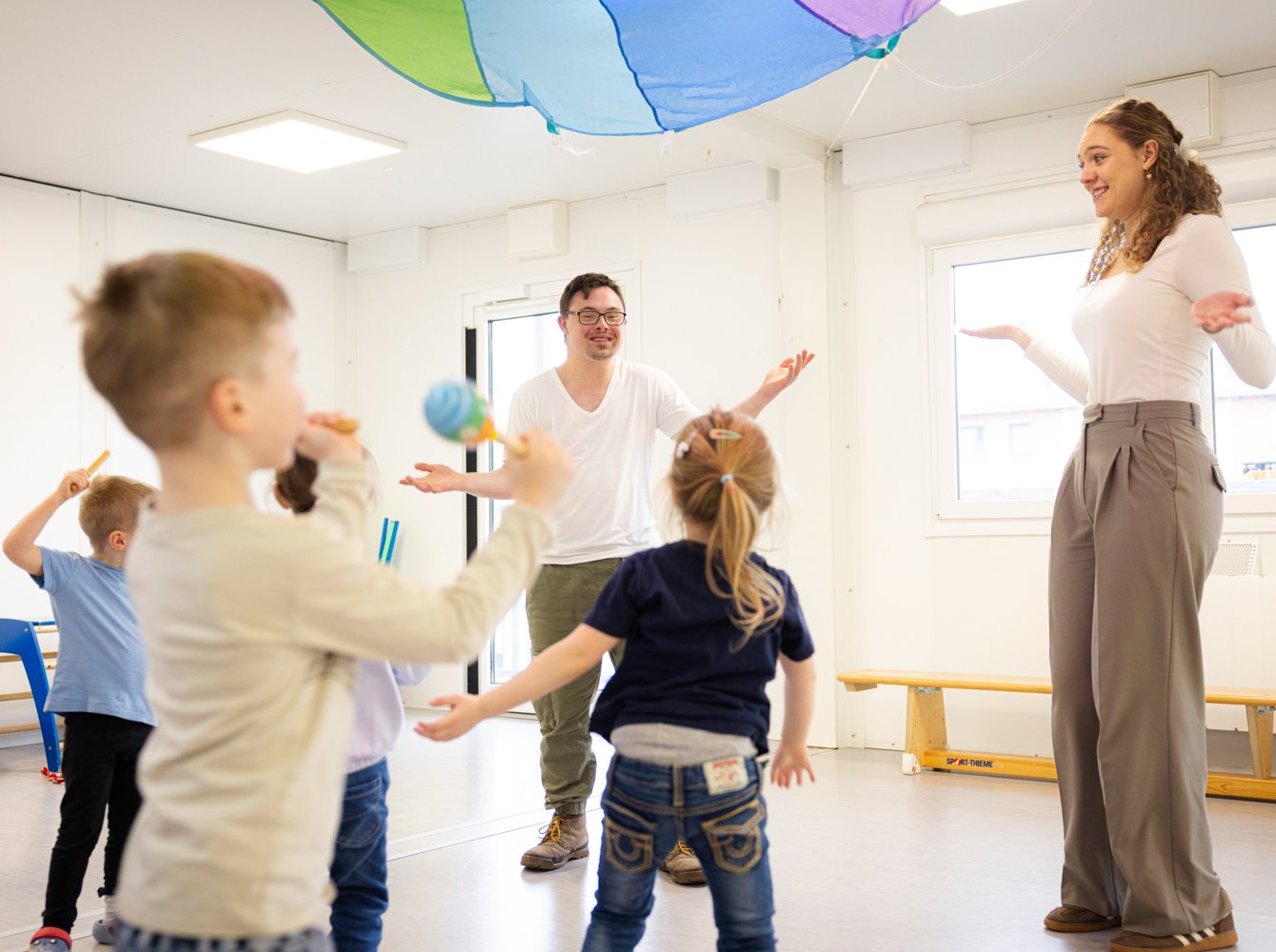
The daycare center management also supported the project from the outset and won over both parents and children. In order to get to know each other better, personal visits were arranged in addition to the choir rehearsals. At an appointment in February, Till brought along wooden clappers and rattles – and, above all, his energy. "I've been dancing for 16 years," he says confidently. His "cool moves" make the children's eyes light up, especially five-year-old Marlo, who is also fascinated by breakdancing.
Movement connects faster than words
As soon as the first songs start playing, there's no stopping them. Led by Helen Schulschenk and Svenja Dirnberger, educator and deputy daycare center manager, the participants become more and more involved with each other. The room fills with rhythm, laughter, and movement. Their experience shows that "children have no barriers or prejudices." Differences arise more from the different ways people interact with each other. That's precisely why the additional visits are so valuable.
The response confirms the concept. Because more and more children want to participate, a second group is already being planned. Cooperation between the daycare center and the workshop has been going on for some time – for example, through the bakery or garden center, as well as through a workshop employee who works outside the daycare center on a daily basis. But the choir project is the largest joint venture between the two institutions to date.
Trust grows through shared experiences
After a short time, there is no trace of the initial reserve. Children and adults sing and dance together. When Till shows off his breakdancing skills at the end, everyone is amazed – and immediately tries out the moves themselves. The most touching moment follows without music: a spontaneous hug from a child for the dancer. What a beautiful gesture of appreciation!
The fact that the group simply wants to sit together and continue laughing after the official conclusion speaks for itself. Trust is not created here through words, but through shared activities.
"Our goal is to build lasting trust through these encounters," says Helen Schulschenk. The development within just one hour shows that inclusion works best where people really meet – with movement, music, and joy. (hk)