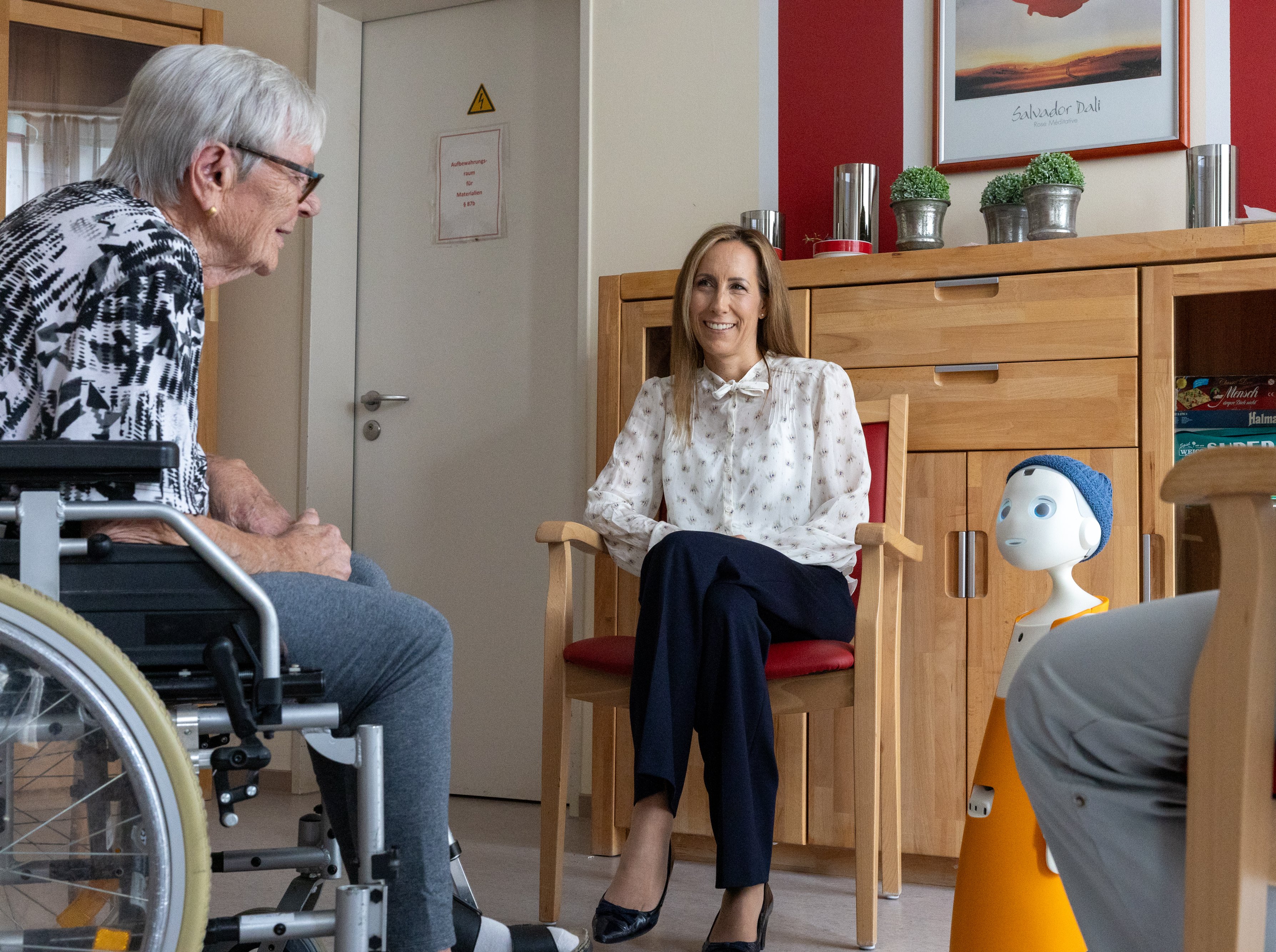
"Hi, Max."
AI Robot Impresses State Parliament President Astrid Wallmann During Visit to the EVIM Senior Center in Walluf — Pilot Project Kicks Off.
“Hello, Max.”
No sooner are those two words spoken than the little robot’s big, round eyes begin to glow blue. He looks at Astrid Wallmann with a friendly expression and politely welcomes the president of the Hessian State Parliament to their first conversation together. A few seconds later, an astonishingly natural conversation unfolds about the senior center, the residents’ daily lives, and later, in the living area, even about democracy and state legislative elections. Time and again, “Max” asks follow-up questions, listens, and builds on what has been said.
“My expectations were more than exceeded,” says Astrid Wallmann at the end of her visit. “The people here are pioneers in Hesse when it comes to technology as well. I’m curious to see how this will develop for EVIM and Hesse. It’s my first meeting with a robot—someday it will surely be part of everyday life.”
It’s a morning filled with curiosity, open conversations, and genuine enthusiasm. Together with representatives from Diakonie Hessen, the State Parliament President visits the EVIM Senior Center in Walluf to experience the AI-powered assistance robot in practical use for the first time. The pilot project had already been presented during a visit to the Ludwig-Eibach-Haus back in May. Now, Astrid Wallmann wanted to see for herself how artificial intelligence actually integrates into the daily routine of a long-term care facility. “Care is an issue that affects us all—even more so in times of an aging society,” she says. “That’s why we need good and innovative solutions.”
Technology That Facilitates Interactions
For three and a half weeks now, “Max” has been part of daily life at the Walluf Senior Center. As the first EVIM senior center and one of the first residential care facilities in Hesse, the center is using the social robot developed by Navel Robotics. The purchase was made possible by donations totaling around 35,000 euros.
But one thing is immediately clear: the focus is not on the technology, but on people. “‘Max’ is explicitly not a care or assistance robot and does not replace staff members,” emphasizes Ilka Müller, managing director of EVIM gGmbH in the field of senior care. “It is intended to provide additional inspiration for care and social participation. If both staff and residents benefit equally from its use, we have achieved our goal.”
Whether it’s memory training, music, poetry, proverbs, or conversations about residents’ life stories—the robot offers ideas, asks questions, remembers the content of conversations, and supports care staff in making group and individual activities engaging. Responsibility remains in the hands of the staff at all times.
The road to this point was longer than expected
Several months of intensive preparation passed before “Max” could actually be put into use. Data protection, technical infrastructure, consent forms, organizational processes, and training placed significant demands on the team. “We underestimated the effort required in some areas,” says facility director Stephanie Raesch. “Data protection in particular, along with the many conversations with residents and their families, took significantly more time than expected. But today we can see that this careful approach has paid off. Acceptance is high—and a real sense of excitement has taken hold within the team. Many feel they are part of an innovative project.”
Technically, too, not everything went smoothly. Firewall settings had to be adjusted, software had to be updated, and the robot’s autonomous navigation is still under development. For the team, these challenges are now simply part and parcel of a pilot project.
Skepticism quickly gave way to curiosity
Care Services Manager Jakov Micic was also initially hesitant. A visit to a facility that was already working with the robot changed his perspective. “The decisive factor for me was that we could help shape the content. ‘Max’ adapts to our needs—not the other way around. He supports our work and focuses on the people who live here.”
A short while later, the guests see just how well this is working in the living area. Together with care worker Armin Ulbig, “Max” talks with 85-year-old resident Margarete Gaida about her favorite dishes, childhood memories, and big family celebrations. A lively conversation develops from a few short questions. Ms. Gaida talks about cooking together, the delicious bean stew, and other dishes that used to be prepared for the whole family, and smiles. “I liked that,” she says afterward. “I was on board right away when I heard about the robot.”
Armin Ulbig had to get used to his new colleague at first. “At the beginning, a lot of people were skeptical—me included, by the way,” he says with a laugh. “But he just looks so friendly. He’s a real help, especially during group activities. When we play ‘Name, City, Country’ and look for a river starting with X, he never runs out of ideas. Working with him is really fun now.”
Digitalization Needs the Right Conditions
Early experiences already show that “Max” can noticeably lighten the load for care staff. Discussion sessions no longer require time-consuming preparation. Instead of gathering materials, staff can focus more on the people. At the same time, new opportunities for conversation arise that spark memories and promote social participation. For Christian Tag, CEO of Diakonie Hessen, the project’s significance extends far beyond Walluf. “The empathy robot Max demonstrates the future potential of care: Digital technologies can ease the burden on caregivers and enable greater participation. For such approaches to be effective, practical experience must be consolidated and translated into a binding strategy. Digitalization is not an add-on, but central to future-proof care—and it requires reliable funding.”
EVIM also views the pilot project as a starting point for further steps toward digitalization. Voice-assisted documentation, smart building technology, and service and cleaning robotics are examples of developments that could make day-to-day work easier in the future, reports Ilka Müller. “If these projects visibly and tangibly benefit people, it’s money well spent,” said EVIM Board Member Jörg Wiegand.
At the end of the visit, one thing stands out above all else: the open atmosphere, the many interested questions, and the joy of breaking new ground together. Time and again throughout the morning, the same insight emerges: artificial intelligence delivers its greatest benefit not when it replaces people, but when it facilitates human interaction.
Or, as Astrid Wallmann put it as she was leaving: “This is a real highlight.” (Text: evim/hk; Photos © Hessian State Parliament)