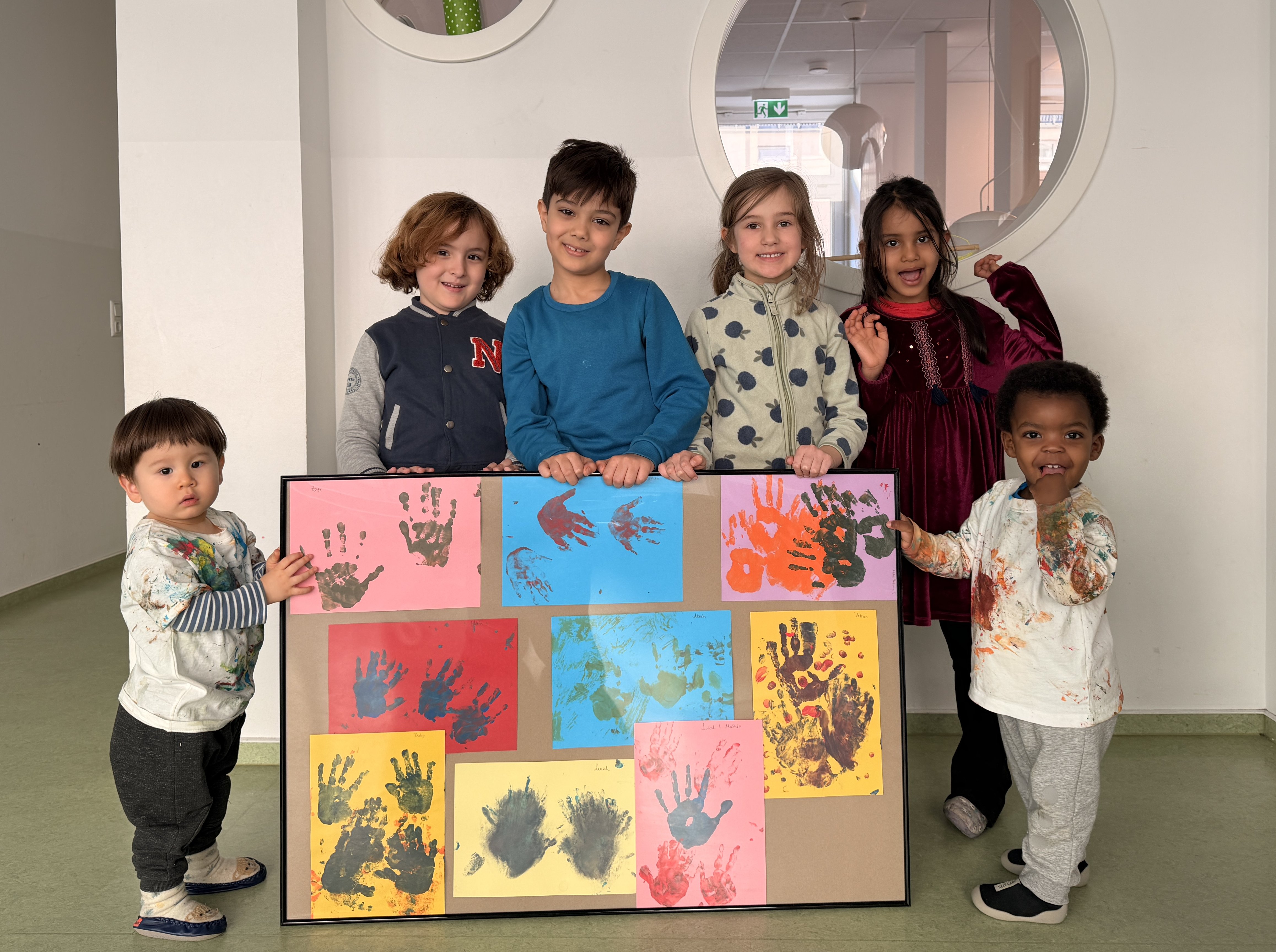
Discover the world with all your senses
A toddler dips his hands in paint, looks at them for a moment, and then gently presses them onto the paper. He feels the cool texture, watches the mark that forms, and touches it again. No words are needed—curiosity, concentration, and discovery speak for themselves. This is where learning begins in a special hands-on project led by a student teacher at the EVIM Haus der Kinder Bleichstraße.
Such exciting moments are at the heart of the project “Discovering Our World with All Our Senses,” which Khadeeja Muhamud, a trainee early childhood educator in her practical training year, implemented in the nursery section of the EVIM facility.
The project draws on key concepts from the educational curriculum. It describes how children engage with their environment from the very beginning through sensory experiences, movement, and active exploration. Perception, physical experiences, and creative activities form important foundations for early childhood educational processes. “I’m fascinated by how fundamental and intense learning is at this age. Development is immediately visible here—small steps mean big progress,” says the 25-year-old early childhood education trainee at the Sophie Scholl School, describing her motivation for the project.
Learning through Relationships and Perception
Her work with the youngest children evolved over the course of her training. During an internship in a nursery setting, she witnessed how intensely children discover their environment through sensory perceptions and their bodies. “I was particularly impressed by how much children can already express and learn without many words,” explains Khadeeja Muhamud. Interests and needs often manifest nonverbally at this age—through eye contact, gestures, movements, or repeated experimentation.
This is precisely why sensitive observation is so important. Early childhood educators perceive these signals, interpret them, and guide the children through their discovery processes. During the nursery years, children gain foundational experiences that are crucial for their future educational development.
A studio for little sensory explorers
The project idea ultimately emerged from intensive observations of daily life. Time and again, it became clear how much children learn through touching, playing in the mud, pouring, painting, and interacting with different materials. “At this age, sensory perception is a crucial foundation for discovering the world. It was important to me to systematically observe the children’s impulses and take them seriously.”
She set up a small studio for the project. Once a week, the five participating children meet over a project period of about two months to experiment, feel, and create with different materials.
That is why the term “sensory explorers” was deliberately chosen. The focus is not on the finished result. “It’s not about a beautiful product. It’s about the experience, about trying things out, and about independent discovery. I prepare the environment without dictating the process,” she explains. This is how the children experience self-efficacy: they act independently, discover connections, and realize that their actions have meaning.
Creating space – providing security
Implementation in the nursery setting also requires clear structures. Short sequences, individual support, and reliable routines are crucial—an insight she gained time and again throughout the project. “Not every activity is suitable for every child at the same moment. How a child is feeling that day, their need for closeness, or tiredness strongly influence participation,” observes Khadeeja Muhamud.
One central question guided the entire project: How can space for independent discovery be created without overwhelming children or directing them too heavily?
The balance between free exploration and safety requires constant reflection—and makes educational work in the nursery setting particularly challenging.
Encounters within the facility
Another component of the project is opening up the facility. Preschoolers participate in a project unit and interact with the younger children.
“The older children show great interest in the younger ones. For the nursery children, they are familiar faces. This way, they experience that their discoveries are noticed and valued.” This cross-group interaction strengthens the sense of community within the facility and makes educational processes visible.
Making Early Childhood Education Visible
With her project during her internship year, the aspiring early childhood educator aims to demonstrate how significant education is even in the earliest years of life. “When children are allowed to discover their world with all their senses, they develop curiosity, self-confidence, and a joy of learning. This is exactly where education begins,” Khadeeja Muhamud is convinced.
With her project at the EVIM Children’s House, she aims to make it clear: Early childhood education is a conscious, professionally informed process—and begins where children actively discover and shape their environment through sensory experiences.
“This project impressively demonstrates how commitment, keen observation, and an inclusive attitude can work together—and how significant sensory experiences are for early childhood development,” confirms Anja Pastaa, facility director. (hk/kmu; Photos: kmu)